What Causes Hip Pinching in the 90/90 Stretch
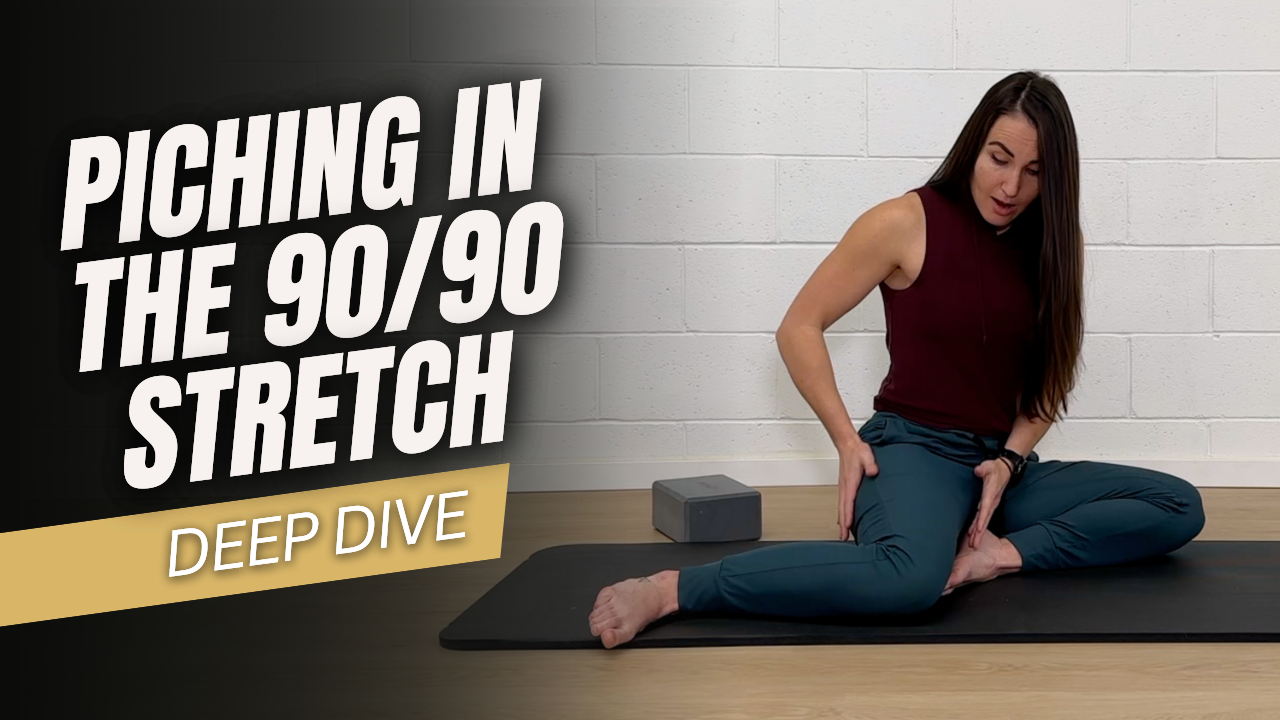
Pinching in the hips during the 90/90 stretch is a really common one that people experience. So let's go through it.
First Things First: Is It Actually Pinching?
One of the first things we need to dissociate is the difference between pinching and cramping — because these are not the same thing, and many people unknowingly get them confused.
In the front of your pelvis, there's a very sharp, pointy bone called your ASIS. If you're standing and you bend forward by folding at the hips, then run two fingers along that crease, you'll find it toward the outside. Now reference where your pinching sensation is relative to that.
If the sensation that you feel is just outside of that bone, what you're likely feeling is more likely to be your tensor fascia lata cramping — not pinching. That cramping can happen for various reasons, but the most common is that you simply haven't trained that position before and your system doesn't know how to operate in that range of motion yet. Alternatively (or additionally) you may have a very restricted hip and therefore have extra resistance in that range of motion, which can also contribute to cramping. These things typically improve with time and with training.
The pinching that people report — the closing-angle sensation, the joint stuff — tends to live on the inside of that bone, more toward the front of the hip. That's what we're going to dig into below.
A Restricted Posterior Hip Capsule
This is the one you'll hear discussed most commonly.
Your capsule is a large connective tissue structure that wraps around (encapsulates) your hip.
Tightness in the back of your hip capsule can actually drive pinching in the front of your hip. Posterior hip capsule work and progressive exposure and loading can be quite helpful here.
The Femur Sitting Slightly Forward in the Socket
Related to the above, but worth naming separately: if the femur is sitting slightly anteriorly in the hip socket, that can contribute to pinching in the front. With that said, it's worth asking why that's happening.
That same posterior capsule tightness can be a driver. But so can excessive tension in the musculature at the front of the hip — which brings us to the next common cause of pinching.
Hip Flexor Dysfunction
Yes, hip flexor dysfunction can contribute to that pinching sensation in the front of the hip.
And here's something that might be counterintuitive — the feeling of tightness in the front of the hip doesn't always mean the hip flexors are short and overactive. Sometimes what you're actually dealing with is a hip flexor that's long, underloaded, and not doing its job well. The body can “guard” your hip flexors as a response, and it feels like tightness even though the tissue isn't actually short. In cases like this stretching your hip flexors more isn't always the answer.
That said, there are absolutely presentations where the hip flexors are genuinely shortened — somebody who is very sedentary, doesn't work in those ranges, and so on.
But a really common clinical finding is that somebody is living in excessive lumbar lordosis or anterior pelvic tilt, and they're struggling to create proper intra-abdominal pressure or pelvic stability.
They may also have trouble breathing well and utilizing their diaphragm properly — and the diaphragm is fascially continuous with the hip flexors, meaning they're very intimately connected even though we think of them as separate structures. If somebody is struggling with their hip flexors and experiencing pinching in the front of their hip, exploring breathworth can be really helpful. Especially if that breathwork is done in positions that help to draw the pelvis out of anterior tilt and teach you how to stabilize and pressurize to generate lumbo-pelvic stability. This now brings us to our next common culprit.
The Lumbopelvic Complex
This one gets overlooked a LOT.
The 90/90 position actually demands a lot from your lumbar spine and pelvis. If somebody has significant restrictions in those areas — if they struggle to move their pelvis or to dissociate their hip from their lumbar spine — the hip can very quickly seem (and feel) like the problem, when really it's paying the tabs for a lumbar/pelvic complex that lacks freedom to move.
So if you've been grinding away at hip mobility and not making progress, or you really struggle to sit upright in a 90/90 position, it is sometimes worth looking further up the chain.
Hip Pathology
It's also worth touching on the fact that some people will have underlying hip pathology that can contribute to this presentation, and that's always worth getting assessed and ruled out.
Common pathological causes of pinching in the front of the hips are labral tears and something called femoroacetabular impingement, or FAI. This is where we see alterations to the bony morphology in the front of the hip and it is typically diagnosed with imaging.
FAI is not a death sentence as a lot of people have the bony morphology and feel nothing, because their system as a whole is functioning well around it (this includes the lumbar spine, pelvis, and lower extremity).
That said — even if you do have something like a labral tear or FAI — it's still worth asking “why”. A lot of the things we've already gone through can be sneaky contributors to injuries or tears over time. That is not to say that they “always” are, but they “can” be and are worth ruling out. These are things you can discuss with your rehabilitation practitioner to rule out in your case.
90/90 Shouldn’t be a Start Point
Within OHF, the hip classes intentionally don't start with 90/90 — we expose you to a lot of other positions and setups first that build toward it and offer alternatives. This is intentional. The 90/90 position is not a great “entry point” for hip mobility as it is (very) often too demanding for people who have existing limitations in their hip, pelvis, and/or lumbar spine.
As such, we expose you to various other positions and setups as “stepping stones” towards more demanding exercises like the 90/90.
If you're not inside OHF yet and want to get a sense of what that looks like, I'll link some free YouTube examples below.
And if you want to dive in, links to learn more about getting started with OHF are included here for you as well.
Written by: Alex Murphy | Physical Therapist, Kinstretch Instructor, FRCms, FRSC, FRAs, FR
This blog and content is for educational purposes only and does not constitute physical therapy, medical advice, or a patient-provider relationship. While the author is a trained physical therapist, nothing here should be taken as clinical guidance specific to your situation. If you're dealing with pain, please work with a qualified healthcare provider who can assess you directly.